- Accounting Software
- Business Management Software
- Distribution & Wholesale Software
- E-commerce Software
- Retail Point of Sales Software
- Fixed Asset Accounting Software
- GST Accounting Software
- Internet Accounting Software
- Sales Ordering Software
- Inventory Management Software
- IRAS Compliant Accounting Software
- SQL Server Software
- Mobile PDA Accounting Software
- Small Business Accounting Software
- Purchase Ordering Software
 Links:
Check it out!
The
Best Accounting Software
Products in Singapore
|
A21 family of accounting software
are fully compliant to the
GST reporting regime in Singapore.
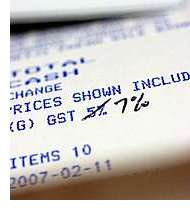 Introduction to Singapore Goods and Services Tax Introduction to Singapore Goods and Services Tax
The Goods and Services Tax (GST)
in Singapore is similar to Valued
Added Tax (VAT) imposed in many
other countries and was introduced
in Singapore since 1st April 1994.
The GST Act is modeled on the UK VAT
legislation and New Zealand GST
legislation. The Inland Revenue
Authority of Singapore (IRAS) acts
as the agent of the Singapore
government and administers,
assesses, collects and enforces
payment of GST.
Introduction of GST gives the
Government the means to lower
personal and corporate income tax
rates while maintaining a steady
revenue base. GST is an indirect tax
as it taxes expenditure. The current
rate of GST is 7%.
This document contains information
extracted from IRAS and aims to
provide a general overview of the
key concepts of Singapore's GST
system pertinent to Singapore
companies.
What is GST?
Goods and Services Tax (GST) is a
consumption tax that is levied on
the supply of goods and services in
Singapore and the import of goods
into Singapore. GST is an indirect
tax, expressed as a percentage
(currently 7%) applied to the
selling price of goods and services
provided by GST registered business
entities in Singapore.
GST tax is charged to the end
consumer therefore GST normally does
not become a cost to the company.
Businesses merely act as collecting
agents on behalf of Singapore tax
department.
GST - what does it mean for a
Singaporean company?
If you are GST
registered, you are required to
collect GST tax from your customers
for the goods and services rendered
by your company and then pay the
collected tax to The Comptroller of
GST (IRAS). As an
example, if you charged S$1,000 for
your goods or services to a customer in
Singapore, you must invoice your
customer S$1,070 (S$1,000 for your
service plus 7% GST). This GST
amount in the invoice (appropriately
must be called a Tax Invoice) collected on behalf
of IRAS from your
customer must be sent
to Singapore tax department on a
quarterly basis via GST tax filing.
Are Singapore companies
required to collect GST tax?
No unless your company is mandated to
register for GST if your annual turnover exceeds
S$1 million.
When paying GST tax collected
from customers, can the Singapore
company offset the GST tax charged
by its suppliers?
Yes. The GST charged by a company to
its customers is known as output tax
whereas GST paid by the company to
its suppliers is called input tax.
What you pay to (or claim back from)
the tax authorities is difference
between your output and input tax.
If a Singapore company is not
GST registered, can it collect GST
tax?
No. Goods and Services Tax in
Singapore can only be collected by
GST registered entities.
Must a Singapore company
collect GST when exporting goods or
services out of Singapore?
No. Export goods and services are
called zero rated supplies and GST
tax is not applicable.
If a company is not required
to register, is it beneficial to
register for GST?
It depends. If you are required to
register for GST, you have no
choice. Otherwise however, you
should consider the following pros
and cons of GST registration:
Benefits
To the government
- It generates a stable and
predictable tax income in both
good and weak economic
environment.
- It is an efficient tax due
to the comparatively lower cost
of administration and
collection.
- It allows the Government to
lower corporate and personal
income taxes, which in turn
encourages more foreign direct
investment. This leads to
overall economic growth.
To businesses and individuals
- Most large, established
businesses are GST registered -
getting your business GST
registered is often a signal to
customers that your business is
an established business and has
certain size.
- GST is a fairer tax system.
It taxes the self-employed and
wage earners only when they
spend their money.
- GST taxes apply only on
consumption. Savings and
investment are not taxed. This
will encourage people to save
and invest in productive
activities.
- Cost of doing business is
reduced, thereby contributing to
lower prices. Businesses do not
suffer a tax cost due to the
multi-stage credit mechanism
since the real taxpayer is the
end-user.
Drawbacks
- The disadvantage of GST
registration is the
administrative burden that comes
with discharging the duties and
responsibilities of GST
registration.
- One must either study the
intricacies of GST or pay an
accountant to undertake this
work which in some cases can be
a reasonably high cost.
- Being GST registered
effectively increases your
selling price by 7%. Your
customers who are not GST
registered would not be able to
recover the GST you charge. So
although your costs are reduced
because you can recover GST,
your customers might not be too
pleased.
- GST can be a burden to lower
income groups, especially during
times of high inflation when the
7% tax is paid on the increasing
price of daily essentials.
What kind of goods and
services are subject to GST?
GST is charged on taxable supplies.
A taxable supply, is a supply of
goods or services made in Singapore,
other than an exempt supply. A
taxable supply can either be a
standard rated (currently 7%) or
zero-rated supply.
Most local sales of goods and
provision of local services are
standard-rated supplies.
Zero-rated supplies of goods and
services are subject to 0% GST. A
GST registered entity who makes
zero-rated supplies is able to claim
a credit for input tax paid on
purchases of inputs. In Singapore,
exports of goods and provision of
international services are
zero-rated supplies.
GST is not chargeable on exempt
supplies, of which there are two
categories - sale and lease of
residential land; and financial
services.
The difference between zero-rated
and exempt supplies is that an
entity who makes exempt supplies
cannot claim input GST.
Out of scope supplies refers to
supplies which are outside the scope
of the GST Act. In general, they
are:
- Transfer of business as a
going concern
- Private transactions
- Third country sales - refers
to sale of goods from a place
outside Singapore to another
place outside Singapore
- Sales made within Zero GST
Warehouse
What are the GST registration
requirements?
GST is a self-assessed tax and
businesses are required to
continually assess the need to be
registered for GST. GST registration
falls into two categories:
compulsory registration and
voluntary registration.
Compulsory registration
Registering for GST is compulsory
when
- the turnover of your
business is more than 1 million
Singapore Dollars for the past 12 months -
known as the retrospective basis
OR
- you are currently making
sales and you can reasonably
expect the turnover of your
business to exceed 1 million Singapore
Dollars
for the next 12 months - known
as the prospective basis.
Please note that failing to
register will attract penalties.
There are anti-avoidance provisions
to ensure that entities are not
established merely to keep turnovers
less than the threshold and thereby
avoid registration.
Voluntary registration
You may apply to voluntarily
register for GST if you are not
liable to compulsorily register and
you satisfy the following
conditions:
- Your annual turnover is not
more than 1 million SGD, or
- You only supply goods
outside Singapore (out-of-scope
supplies), or
- You make exempt supplies of
financial services that are also
deemed as international services
The advantage of voluntary
registration is that you can enjoy
the benefits of claiming input tax
incurred in the course of your
business. This is especially so when
you make purely zero-rated supplies
(exports or international services).
Please note, once you are
voluntarily registered, you must
remain registered for at least two
years and you have to maintain all
your records for at least five
years, even after your business has
ceased and you have deregistered
from GST. You may also have to
comply with any additional
conditions that are imposed by the
tax authority.
Exemption from Registration
If you make only zero-rated supplies
you can apply for an exemption from
registration, even if your taxable
turnover exceeds the registration
limits. This allows you to escape
from the administrative requirement
of GST registration, as you would
only be reclaiming and not paying
tax to the IRAS, since the cost to
you is the input tax. IRAS will
approve the exemption, if more than
90% of your total supplies are
zero-rated and if your input tax is
greater than your output tax.
De-registration
You can cancel your registration
when your business stops or when
your business is sold as a whole to
another person or when your sales
figures do not exceed 1 million SGD.
You must submit an application form,
along with other relevant documents
to the tax authority within 30 days
from the date of cessation.
What is GST registration
procedure?
A Singapore Goods and Services
registration form (GST F1) along
with the necessary supporting
documents must be sent to the tax
authority. An additional form (GST
F3), giving details of all the
partners must be completed, in the
case of partnerships. Separate
application procedures/forms are
available for overseas companies,
group registration and divisional
registration. Overseas registrants
are expected to appoint a local
agent who will act on its behalf and
must include a letter, along with
the application form, stating the
same.
The registration process takes
approximately 3 weeks. Upon
successful GST registration, you
will receive a Notification of GST
Registration letter. This letter
will contain your GST number, your
filing frequency and filing due
dates as well as any other special
instructions. You must file your GST
returns electronically.
How to pay, charge and
implement GST?
As a GST registered entity, you
are responsible for charging GST on
supply of goods and services and
remitting the GST charged to IRAS.
- You can either charge GST on
top of your selling price or
absorb the GST by treating the
price as GST-inclusive.
- As a GST registered trader
you must show and quote
GST-inclusive prices on all
prices displayed, advertised,
published and quoted verbally or
in writing. Failure to display
GST-inclusive prices to the
public is an offence and carries
a penalty. However, for goods
and services subject to service
charge (F & B industry), prices
displayed may be GST-exclusive.
- When billing customers, a
tax invoice must be issued when
the customer is a GST registered
entity so that the latter can
use it as a supporting document
to claim input tax on the
standard-rated purchases. It
contains information on what is
being sold and the respective
GST charged and can be used to
replace a normal invoice. Tax
invoices must be retained for at
least five years as part of your
business records. Note that tax
invoices are not required to be
submitted along with your GST
returns. In general, it is to be
issued within 30 days of the
time of supply. A tax invoice
need not be issued for
zero-rated, exempt and deemed
supplies or to non-GST
registered customer.
- When payment has been made
to you, you must issue a
serially printed receipt to the
payer if a tax invoice or
simplified tax invoice has not
been issued by you.
- You must keep records of all
your business transactions that
affect your GST declarations.
Additionally, keeping of a GST
account (summary of the totals
of your input tax and output tax
for each accounting period) will
facilitate your completion of
GST returns.
- You should make your input
tax claims in the accounting
period according to the date of
the tax invoice or import
permits.
How to file GST returns?
As a GST registered entity, you are
required to submit a return, (GST
F5) to the tax authorities based on
your accounting cycle, normally on a
quarterly basis. In your return, you
will indicate the total value of
your local sales, exports and
purchases from GST registered
entities, the GST collected and GST
claimed for that accounting period.
GST Returns are now filed
electronically. Once you have
started to e-file your GST F5, your
next GST return will be made
available online by the end of each
accounting period. You can e-file
your GST F5 one day after the end of
the accounting period. You must
ensure that IRAS receives your
return not later than one month
after the end of your prescribed
accounting period. If there is no
tax due for the said period, you
must still submit a ‘nil’ return.
Penalties will be imposed if you
file the GST return late. This is
regardless of whether the net GST
declared is a payable or refundable
amount.
You must pay the net GST within 1
month after the end of your
accounting period. Penalties will be
imposed if you are late in making
the GST payment. GST refunds will
usually be made within 30 days from
the date of receipt of the return.
Are there any GST Schemes to help
businesses?
The Singapore Government has
introduced several assistance
schemes relating to GST. These
schemes generally help to ease the
cash flow for businesses and help
create a pro-business environment.
- Tourist refund scheme,
allows tourists who buy goods in
Singapore from participating GST
registered retailers to claim a
refund of the GST paid if the
goods are brought out of
Singapore
- Cash Accounting Scheme, is
specifically for small
businesses whose annual sales do
not exceed SGD 1 million.
- Under the Gross Margin
Scheme, GST is chargeable only
on the gross margin of your
goods.
- The Major Exporter Scheme (MES),
is designed to help the cash
flow of major exporters who have
significant imports.
- Under the Approved Contract
Manufacturer and Trader (ACMT)
Scheme, you are not required to
charge GST when you are
instructed by your overseas
customer to deliver your
finished goods to his customers
in Singapore. As per the
Approved Marine Fuel trader (MFT)
Scheme, you are not required to
pay GST when you purchase marine
fuel oil from a local GST
registered supplier.
- The Hand Carried Exports
Scheme, is if you wish to
zero-rate your supply of goods
made to an overseas customer and
your goods are hand-carried out
of Singapore via Changi
International Airport.
- Under the Zero GST Warehouse
Scheme, businesses can transform
their warehouses into zero-GST
warehouses to minimize red tape
and bypass the GST process.
- Approved Third Party
Logistics Scheme, allows you to
import goods belonging to
yourself or your overseas
principal without paying GST
upon importation.
|


